

How OpenTelemetry Works
OpenTelemetry combines vendor-neutral components that generate, process, and export observability data in a consistent way.
At a high level, it helps you:
- Specify what should be measured
- Capture and structure telemetry data
- Export that data to an observability backend such as KloudMate
The core components of OpenTelemetry are loosely coupled, so you can choose the pieces that fit your environment.
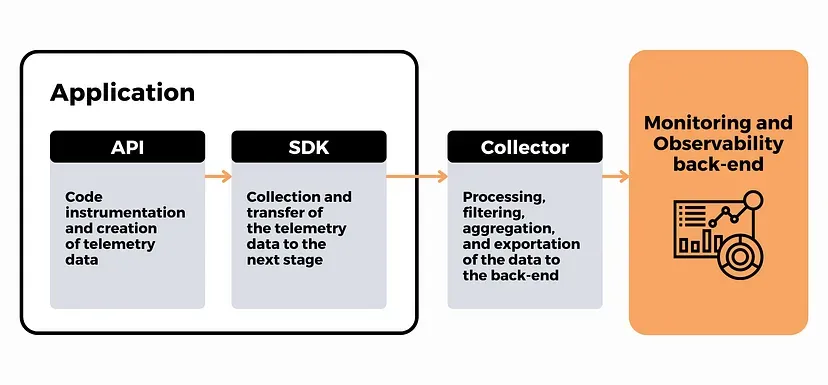
1. Instrumentation
Section titled “1. Instrumentation”Instrumentation starts in your application code or runtime.
APIs define the operations used to generate traces, metrics, and logs and to attach useful context to that data.
2. Data Collection
Section titled “2. Data Collection”SDKs implement those APIs for specific languages and runtimes. They gather telemetry from the instrumented application and prepare it for export.
3. Data Export
Section titled “3. Data Export”The OpenTelemetry Collector is an optional but commonly recommended component. It can receive, process, and export telemetry data before that data reaches the final backend.
Use the Collector when you want to:
- Export telemetry to multiple backends
- Add batching, retries, or encryption
- Filter or redact sensitive data
- Collect host-level metrics such as CPU and memory usage
You can also export directly from SDKs to a backend when your setup is simple and you do not need Collector-side processing.
4. Visualization and Analysis
Section titled “4. Visualization and Analysis”OpenTelemetry generates and transports telemetry data, but it does not provide long-term storage, querying, or visualization by itself.
That final step happens in an observability backend such as KloudMate, where you can search, analyze, and correlate the data.